
A registered trial for an AI diagnostic tool
PUMCH reports that a team led by its radiology department, together with Peking University People’s Hospital, Wuhan Third Hospital, Huangshi Central Hospital and the University of Hong Kong, developed a deep learning model called DeepFAN and completed what the hospital describes as Asia’s first registered clinical trial of AI-assisted discrimination between benign and malignant lung nodules. The results were published in Nature Cancer, and the model has received a Class III medical device registration certificate from China’s National Medical Products Administration (NMPA) — the country’s highest-risk device category.
How the model works
DeepFAN combines three components: a vision transformer that captures the nodule and its surrounding context, a fine-grained 3D residual network that extracts local details such as density, lobulation and spiculation, and a graph convolutional network that fuses the two. It was trained on 11,438 pathology-confirmed lung nodules collected across multiple centres.
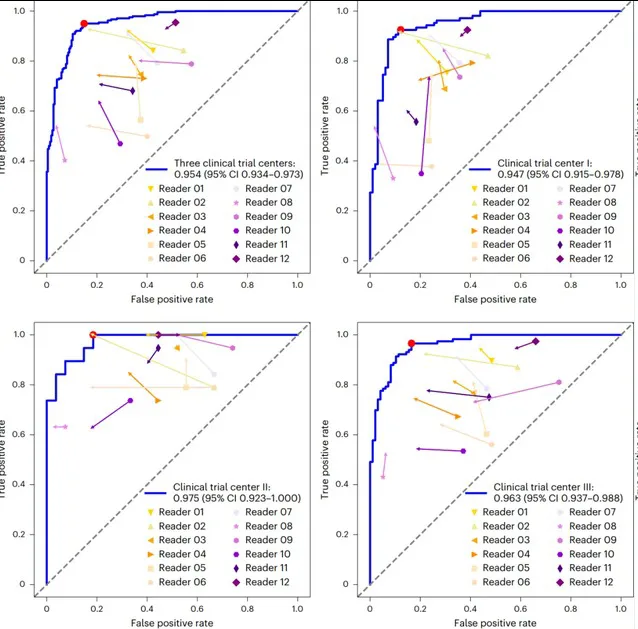
In internal testing the model reached an AUC of 0.939, and 0.943 in external validation on the US National Lung Screening Trial dataset, with a predictive value of 0.992 for benign nodules. In the registered trial — 463 pathology-confirmed nodules from 400 patients across three centres — DeepFAN alone scored an AUC of 0.954. Twelve junior radiologists (1–5 years of experience) averaged 0.667 reading unaided and 0.776 with AI assistance: accuracy rose 10.0%, sensitivity 7.6%, specificity 12.6% and reading agreement 34.5%. These figures come from a controlled trial setting and do not guarantee the same performance in every hospital.
What is still unknown
The trial measured diagnostic accuracy, not long-term outcomes: it does not show that AI-assisted reading reduces lung cancer mortality or the number of unnecessary procedures over time. Participants were junior radiologists, so the added value for experienced readers was not tested. The report also does not describe when or how widely the model will be deployed in routine care, nor its cost or insurance coverage.
What this may mean for patients
For people found to have a lung nodule on CT, the study points toward tools that could make benign-vs-malignant assessment more consistent across hospitals, and — given the high predictive value for benign nodules — potentially reduce unneeded follow-up imaging. This report describes a diagnostic aid for radiologists, not a service patients can request directly, and it is not guidance for interpreting any individual scan.
Relevance to lung cancer care
Lung nodules sit at the intersection of Wellward China’s Respiratory & Lung and Cancer & Tumors health areas. Early, accurate characterisation matters because it shapes whether a nodule is monitored, biopsied or surgically removed. This page is general information, not medical advice.